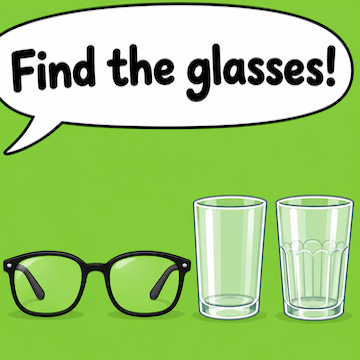
"Glasses" and "Glasses" can mean different things!
Princeton Baby Lab (Princeton University)
Who Can Participate |
Typically developing 3-year-olds who live in the US and hear at least 90% English and 0% Spanish in their everyday life |
What Happens |
In this study, your child will see pairs of common objects on the screen. They will hear the name for one of the objects, and we will use their eye movements to determine if they recognize the words. We are interested in whether children can recognize that the word "glasses" can mean eye glasses and drinking glasses (common meanings in English). We will also test whether they can infer new but related meanings, such as swim goggles (common meaning of the word "glasses"/"gafas" in Spanish). Since we need the last set of meanings to be new to your child, it's important that they do not regularly hear Spanish. Following the study, we will ask you to complete a set of surveys about your child's vocabulary and experience with the words in the study. |
What We're Studying |
Many English words have multiple meanings. For example, the word "glasses" can refer to both eye glasses and drinking glasses, and the word "cap" can refer to both baseball caps and marker caps. How do young children discover multiple meanings for common words? In this study, we will test for the first time whether 3-year-olds can recognize multiple meanings and infer new meanings. Prior research on children's word learning tends to focus on single-meaning words, so this study will help us better understand how children learn words in real life, where they encounter many words with multiple, related meanings every day. |
Duration |
20 minutes |
Compensation |
Within one week, we will email you a $10 Amazon gift card (for Amazon.com). To be eligible for the gift card: 1) your child must be in the age range for this study and meet the language requirement, 2) you need to submit a valid consent statement, and 3) we need to see that there is a child with you. You may only participate once per eligible child. |
This study is conducted by Casey Lew-Williams (contact: babylab@princeton.edu).