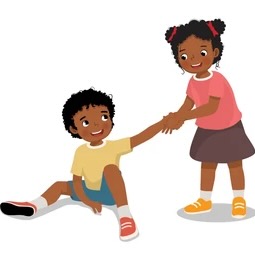
Which helper is the nicest?
SoCal Lab (University of California, San Diego)
Who Can Participate |
For 4.5- to 7-year-olds |
What Happens |
This study will take place on a video call, live with a researcher! Clicking on the “Schedule a time to participate” button will send you to an online calendar where you can select a date and time that works for you. During the appointment, your child will hear a short story about a character who chooses to help someone else. We will then ask your child whether they think the character will help the same person in new situations. |
What We're Studying |
Prior research has shown that children expect people who they see help others will act in other nice ways in the future. However, it is currently unclear whether children consider certain acts of helping as being "nicer" compared to others. For example, you would likely think that someone who opens the door for you when your arms are full is doing something nice, but someone who chases you down the street to let you know that you dropped your wallet is likely considered nicer. This study asks what types of helping children use to determine who is more likely to act in other helpful ways in the future. In this study, children will see one of four different examples of someone helping another person, and then we will ask if they expect the helper to continue helping others in the future. |
Duration |
10 minutes |
Compensation |
You will receive a $5 gift card to the Amazon US site (https://www.amazon.com/). In order to receive this payment, your child will need to be within our specified age range, your child will need to be visible throughout the video, and you will only be able to receive one gift card per child. You will receive payment within 1 week of participation. |
This study is conducted by Dr. Lindsey Powell (contact: Socallab@ucsd.edu).