Why Do Zarpies Do That?
Early Learning and Cognition Lab (University of California, San Diego)
Who Can Participate |
For children ages 5 to 10 years old. |
What Happens |
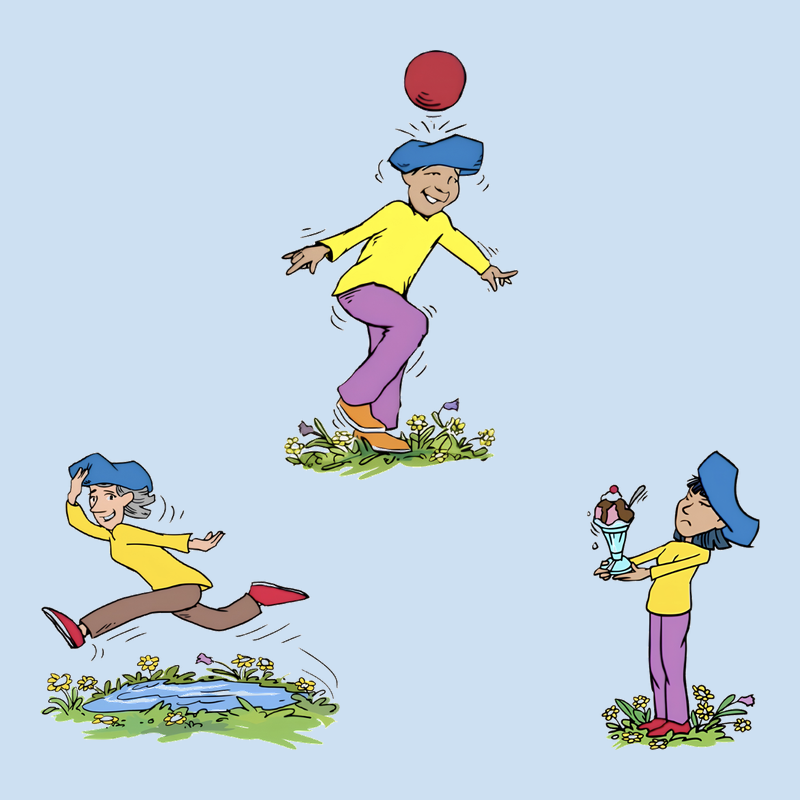
Your child will watch videos about cartoon characters called Zarpies, who live far away and do unusual things: one paints stripes in her hair, and another eats flowers. A narrator explains why each Zarpie does what they do. After each one, your child answers questions by clicking large pictures: whether that behavior is "normal" or "weird" where Zarpies live and how much so, how many other Zarpies do it (on a scale from "none" to "all"), and whether a Zarpie they've never met would do it too. First there's a practice round with the pictures they'll be clicking, and at the end your child says out loud why they think two Zarpies do what they do. Every question is read aloud, so children who aren't reading yet can take part. |
What We're Studying |
When adults explain why someone does something, the wording varies in ways that are easy to miss. "She does that because people like her do that" points at a group; "she does that because she's always done it" points at one person. Earlier research has shown that language implying a group — especially sentences like "Zarpies eat flowers" — leads children to treat a behavior as typical of everyone in that group. What isn't clear is whether that happens because of the sentence form itself, or because of where the explanation locates the cause. This study separates those two things. Every child hears the same four behaviors described the same way; the only difference is whether the explanation points at the group or at that one Zarpie's own history. By comparing how far children in each version extend the behavior to other Zarpies, we can see whether locating a cause in a group is enough on its own. We use invented characters so that we can study how children reason about groups without involving any real group of people. |
Duration |
20 minutes |
Compensation |
As a thank you, we'll send a $5 Amazon gift card by email within two weeks of participating. One gift card per child, and each child can take this study only once. We ask for your email address at the start of the study so that we can send the gift card. |
This study is conducted by Dr. Caren Walker (contact: elclab-coord@ucsd.edu).