Easier Today Than Yesterday? Daily Brain Games Study
The SPARK Lab (Stanford University)
Who Can Participate |
We are looking for parents/caregivers with a child between 5- and 12-years-old! You must have access to an iPad/tablet or smartphone at home to participate in this study. You and your child must be able to answer questions and play game in English, and you must live in the U.S. |
What Happens |
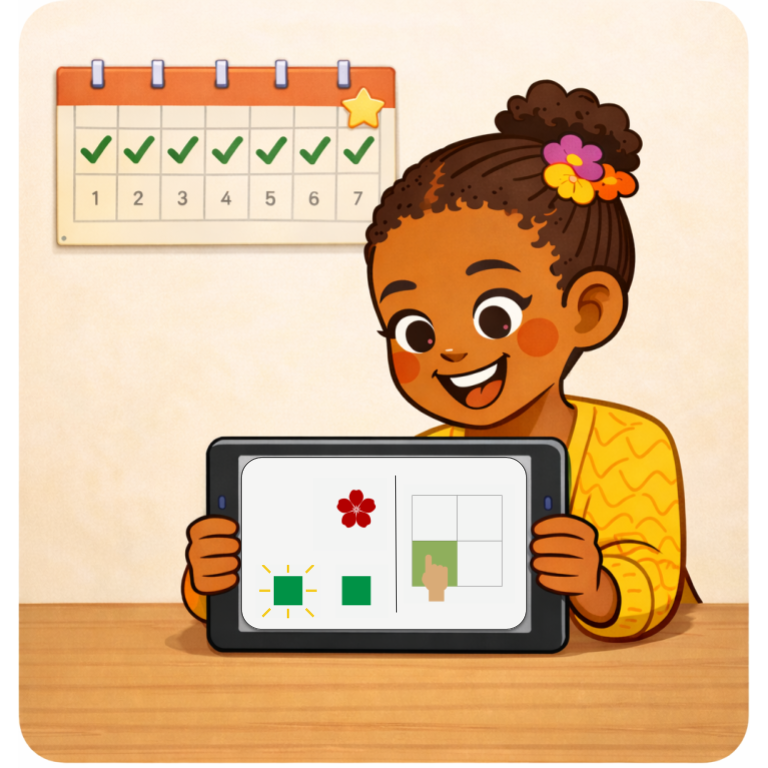
This study will take place on a video call, live with a researcher! Clicking on the “Schedule a time to participate” button will send you to an online calendar where you can select a date and time that works for you. Participation consists of one 45-minute scheduled video call with a researcher, followed by a two-week period of daily assessments (~10min/day). Each day, parents and children will complete a brief survey about the child’s day, and children will play two short games designed to measure learning-related cognitive skills. The first game, Hearts & Flowers, asks children to tap the same side of the screen when they see a heart and the opposite side when they see a flower. Later, hearts and flowers appear together, requiring children to switch between the rules. This game measures inhibitory control and cognitive flexibility. In the second game, the Memory Game, children see a sequence of squares lighting up on the screen and are asked to tap the squares in the same order or in reverse order. |
What We're Studying |
The goal of this study is to understand how children’s day-to-day experiences relate to their learning-related skills, such as cognitive control and working memory (often called executive functions). Prior research on executive functions treats these skills as relatively stable individual traits. However, we believe that children’s executive functions may change from day to day depending on their daily experiences, such as how they slept, how they are feeling, or what happened during their day with family or peers. By following children over multiple days and combining short surveys about daily experiences with brief executive functioning games, this study aims to better understand how everyday experiences may shape children’s cognitive skills. This research will help scientists improve how these skills are measured and better understand how children learn and adapt in their daily lives. |
Duration |
The initial call will last 45 minutes. The home activities (daily games & surveys) will take 1 minute/day for parents for up to 8 days, and 11 minutes/day for children for up to 8 days. |
Compensation |
As a thank you for participating, eligible families will receive up to $75 compensation in the form of Amazon.com gift cards. Eligible families will receive a $25 card for participating in the 45-minute Zoom session, which includes completing brief parent and child surveys and downloading the study games with the researcher. During the Zoom session, families must have their video on and ensure that the participating child is visible in the frame so the researcher can guide the activities. The participating child must be within the study’s eligible age range, and only one session per child is permitted. Gift cards will be sent within one week of the Zoom session. Families may also receive up to $50 in additional Amazon.com gift cards for completing the short, daily at-home activities during the two-week study period. Compensation for the at-home activities will be provided based on the number of days completed, and gift cards will be sent within one week after the two-week period has ended. |
This study is conducted by Jelena Obradović (contact: obradovic-lab@stanford.edu).